Circle8
Home About Strategic Collaboration Global Design Series ↳ Editorial Index Testimonials Round Table ↳ Submit an Opportunity Contact
The Blue Mosque, Istanbul
← Turkey Editions

Mosque · Editorial · Istanbul

The Blue Mosque

Standing in the Shadow of Greatness

Share this edition

"It is impossible to visit the Blue Mosque without thinking about Hagia Sophia. I arrived knowing that — and still found myself stopping at the entrance, trying to understand what I was really looking at."

01

A Building That Knows Its Own Beauty

The Blue Mosque sits directly across from Hagia Sophia in the Sultanahmet district of Istanbul. The proximity is not accidental. Sultan Ahmed I commissioned it in 1609 with the explicit intention of creating something that could stand alongside — and perhaps answer — the architectural authority of the building opposite.

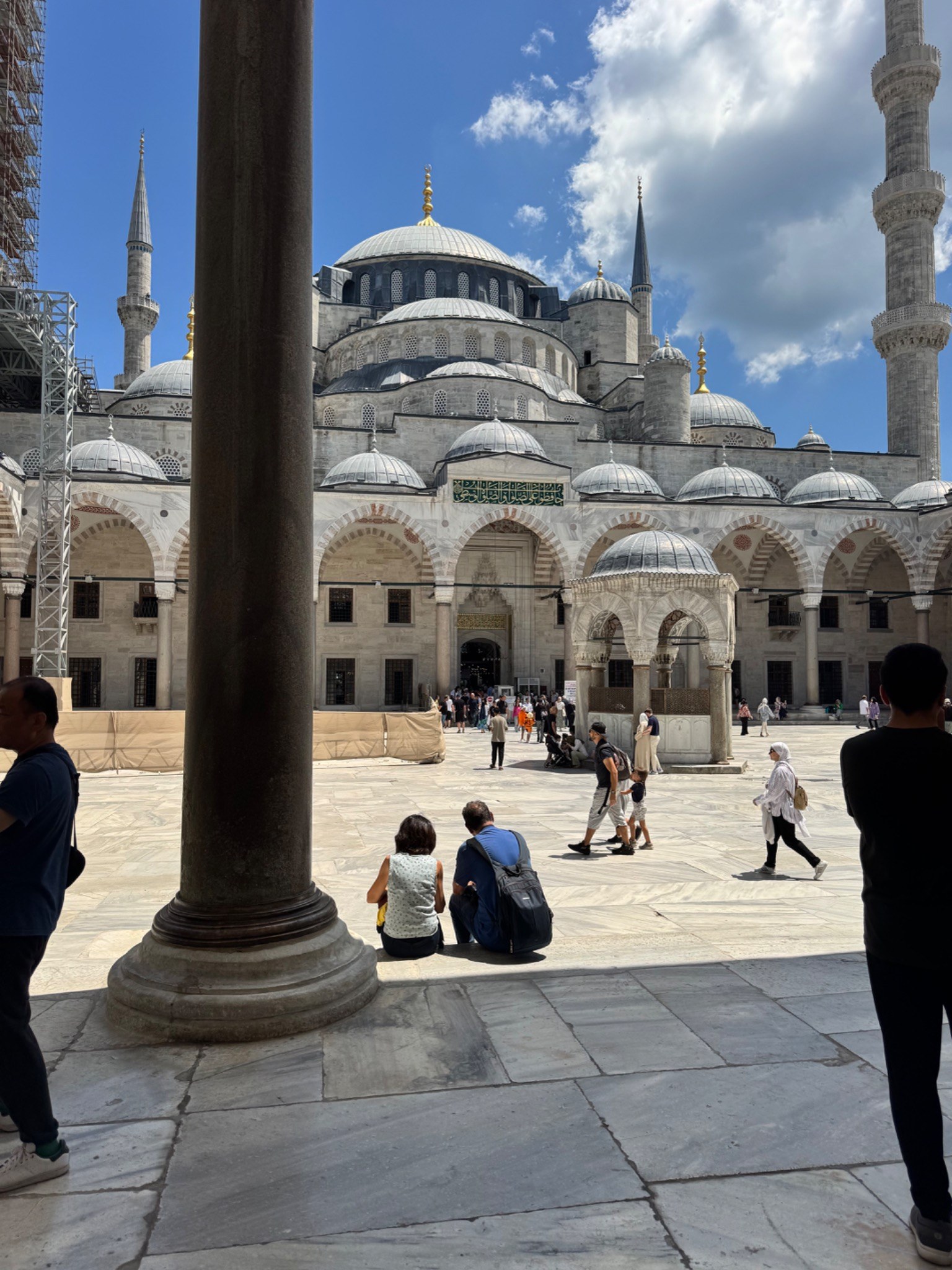
What he built was not a replica. It was a response. The Blue Mosque has its own personality entirely: composed, orderly, and almost serene in its exterior form. Six minarets rise from its corners with a symmetry that feels deliberate and confident. The cascading domes move from large to small in a sequence that feels both logical and effortless — as if the building always knew exactly what it wanted to be.

From the outside, it does not announce itself loudly. There is no single dramatic gesture, no single moment that stops you. Instead it reveals itself cumulatively. The more you look, the more resolved it becomes. That quality — of knowing its own beauty without performing it — is something I have rarely encountered in architecture at this scale.
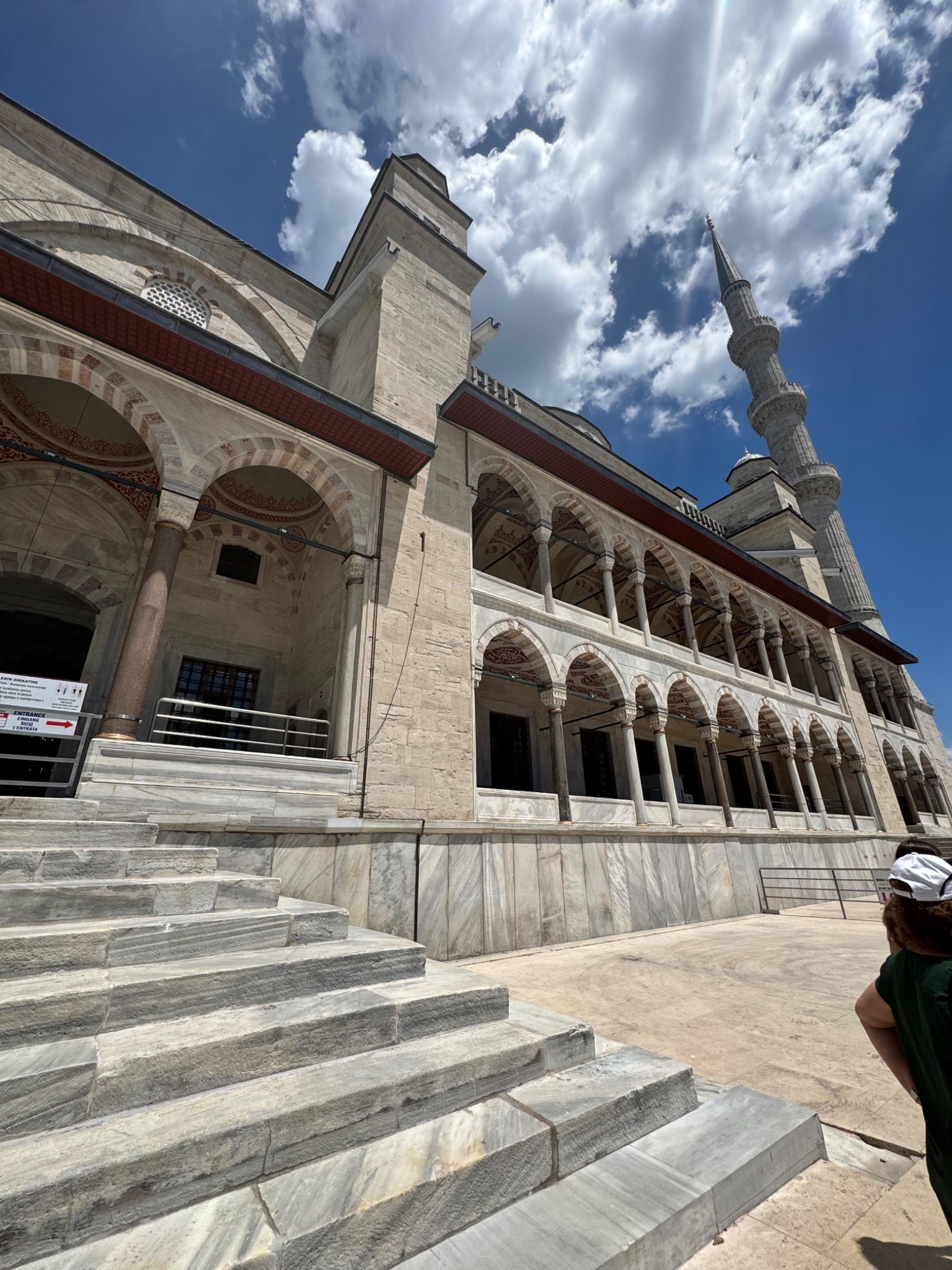
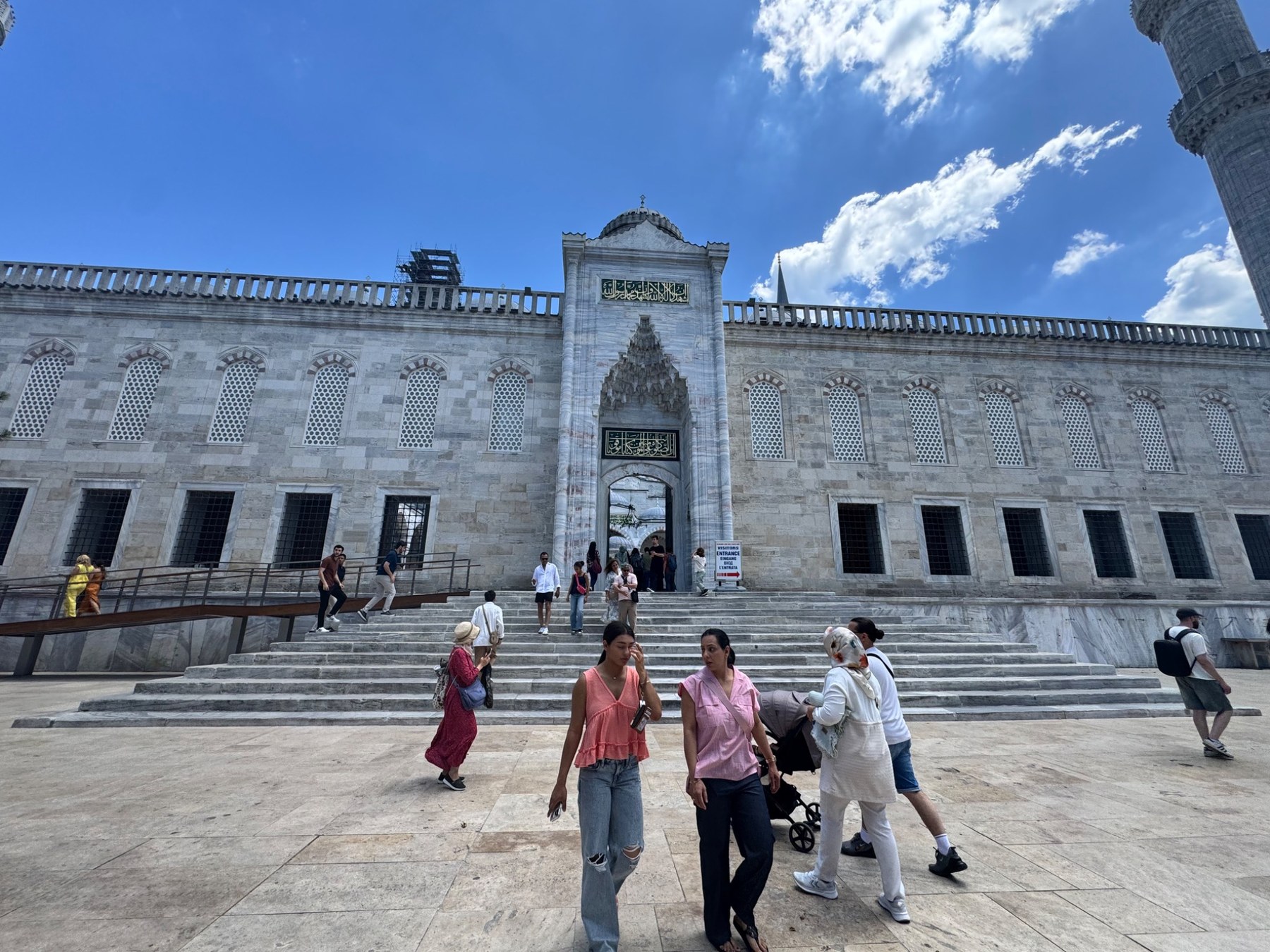
Blue Mosque exterior facade
The cascading domes and six minarets give the mosque a composed, deliberate symmetry
Blue Mosque entrance
Standing in the shadow of Hagia Sophia, the mosque holds its own with quiet authority
02

The Blue That Reveals Itself Slowly

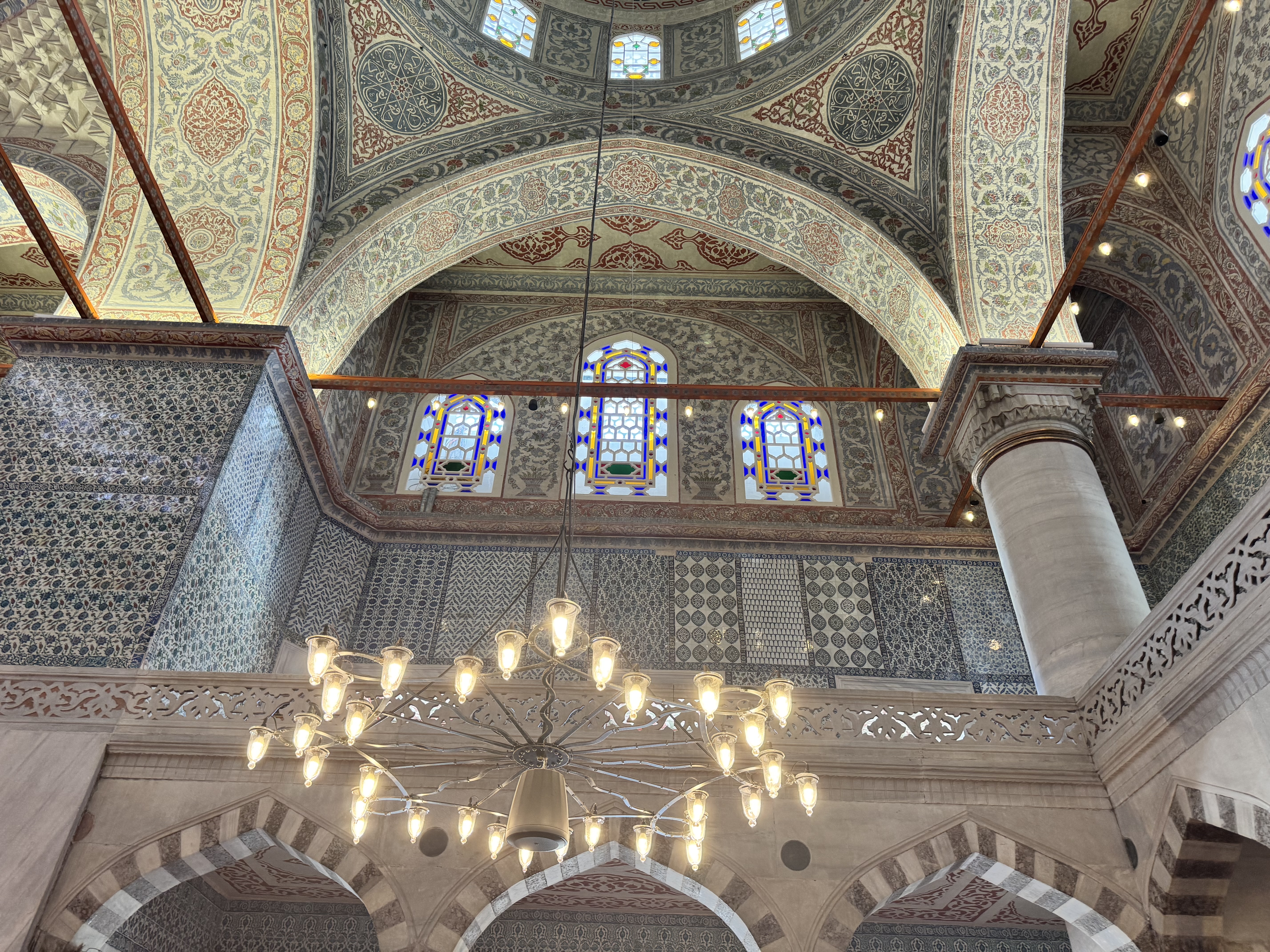
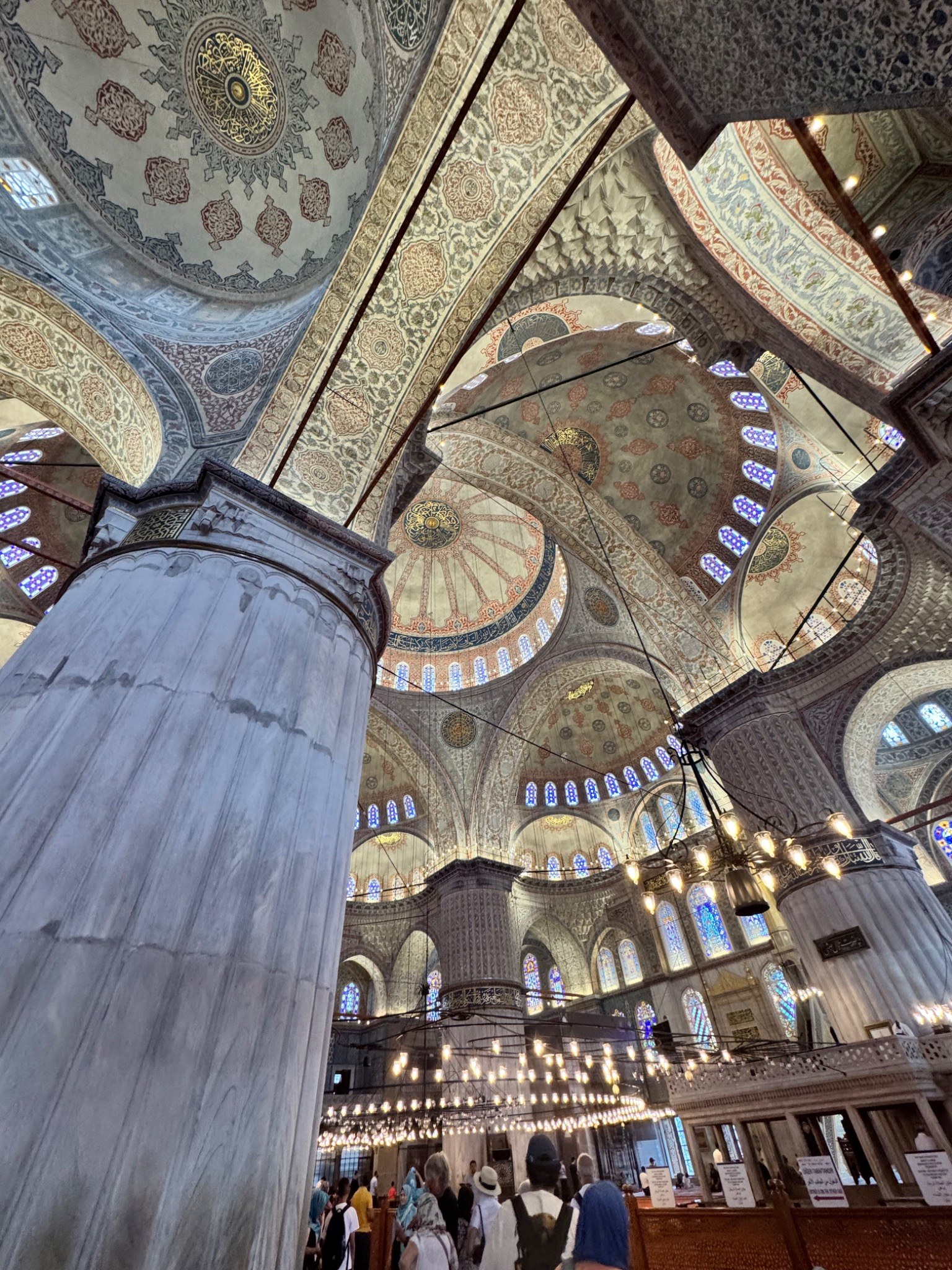
The name comes from the interior. More than 20,000 handmade Iznik tiles cover the walls, domes and semi-domes in patterns of blue and white that are almost impossible to take in at once. At first glance the interior reads as blue — a general impression of cool, layered colour. But step closer and the tiles reveal themselves to be extraordinarily intricate: tulips, carnations, geometric patterns and calligraphy interwoven across every surface.

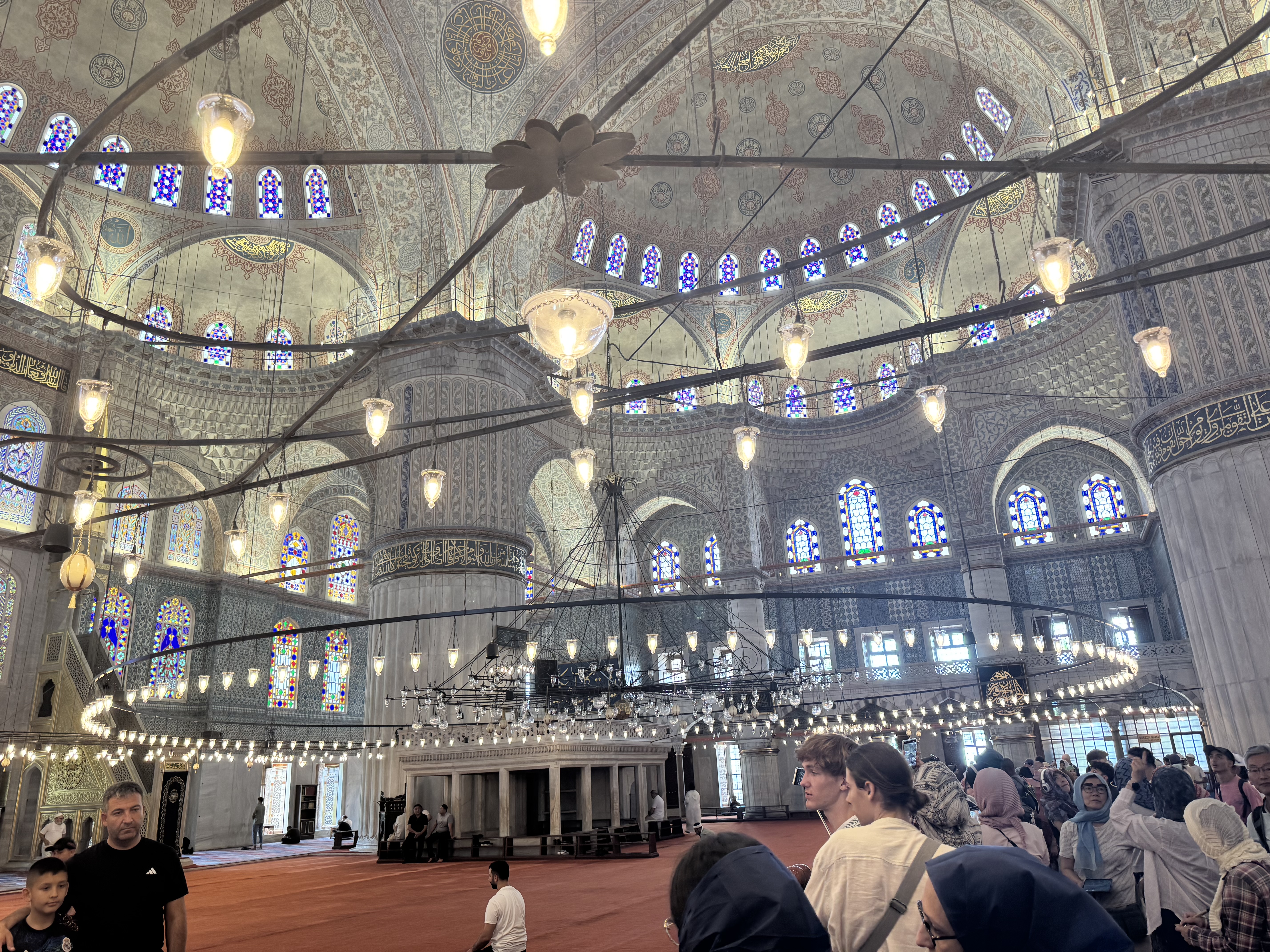
The light changes everything. Natural light filters through 260 windows, shifting throughout the day in a way that makes the tiles read differently depending on when you visit. A surface that seemed flat at midday becomes dimensional in the late afternoon. A pattern that disappeared into the background suddenly advances. The building rewards patience.

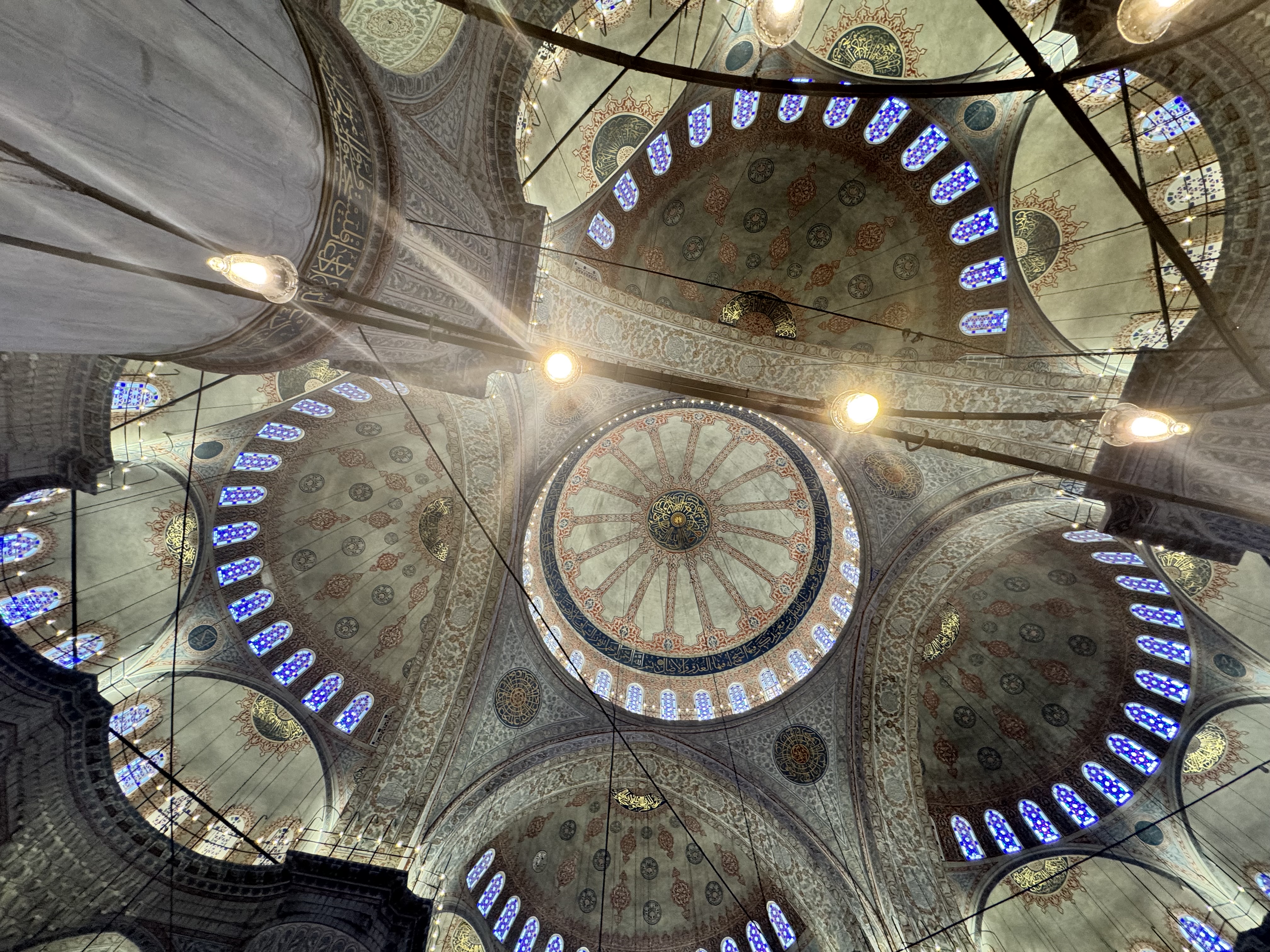
That quality of slow revelation — of a building that gives more the longer you stay — is one of the things I find most compelling about great architecture. It is the opposite of the immediate visual impact that so much contemporary design chases. The Blue Mosque does not try to impress you in the first five seconds. It tries to hold you for an hour.

Blue Mosque interior tiles
More than 20,000 handmade Iznik tiles cover every interior surface
Blue Mosque dome ceiling
Natural light filters through 260 windows, shifting the tiles throughout the day
Blue Mosque interior detail
Patterns of tulips, carnations and calligraphy interwoven across every dome
03

A Courtyard Made For Pause

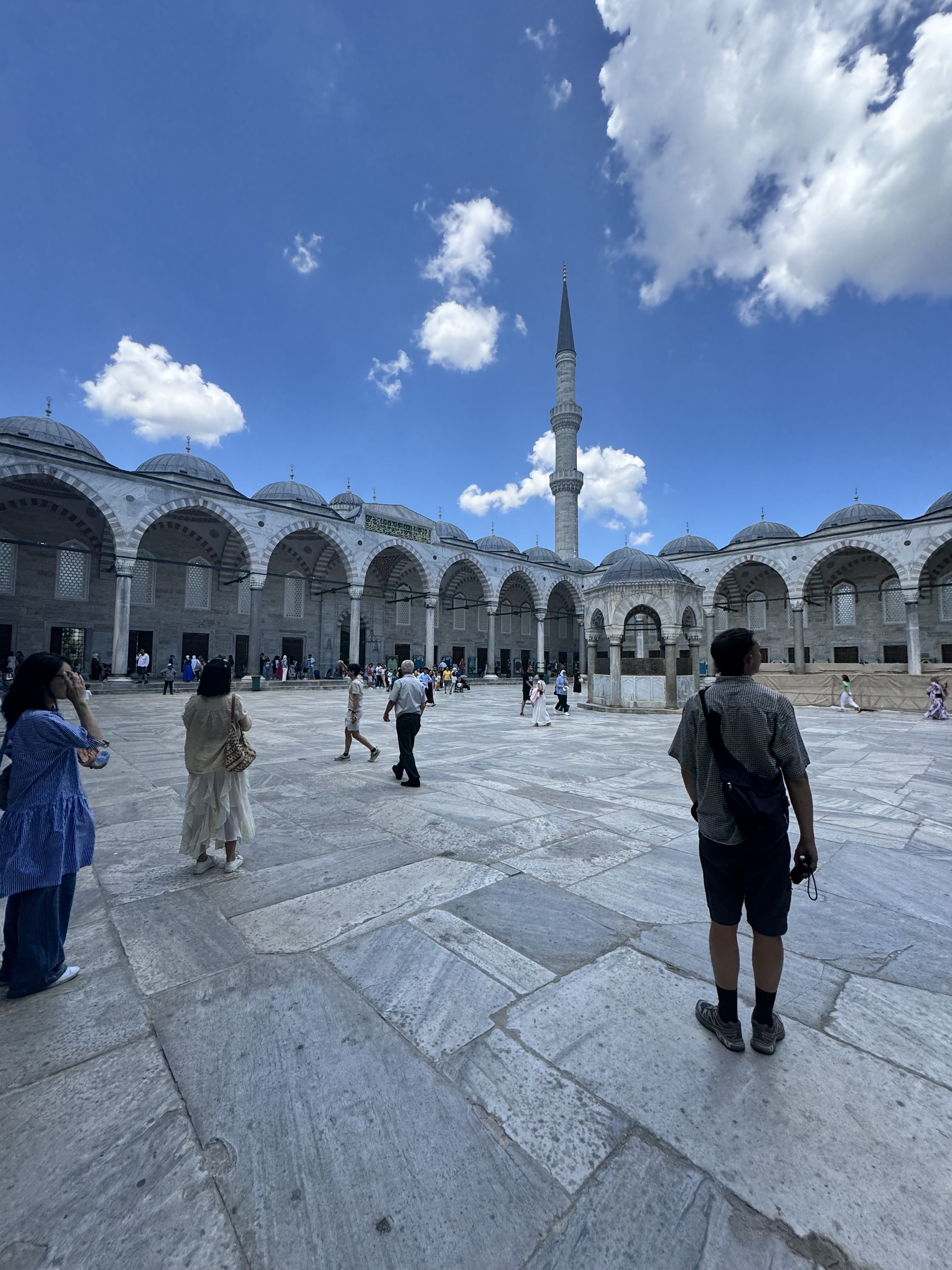
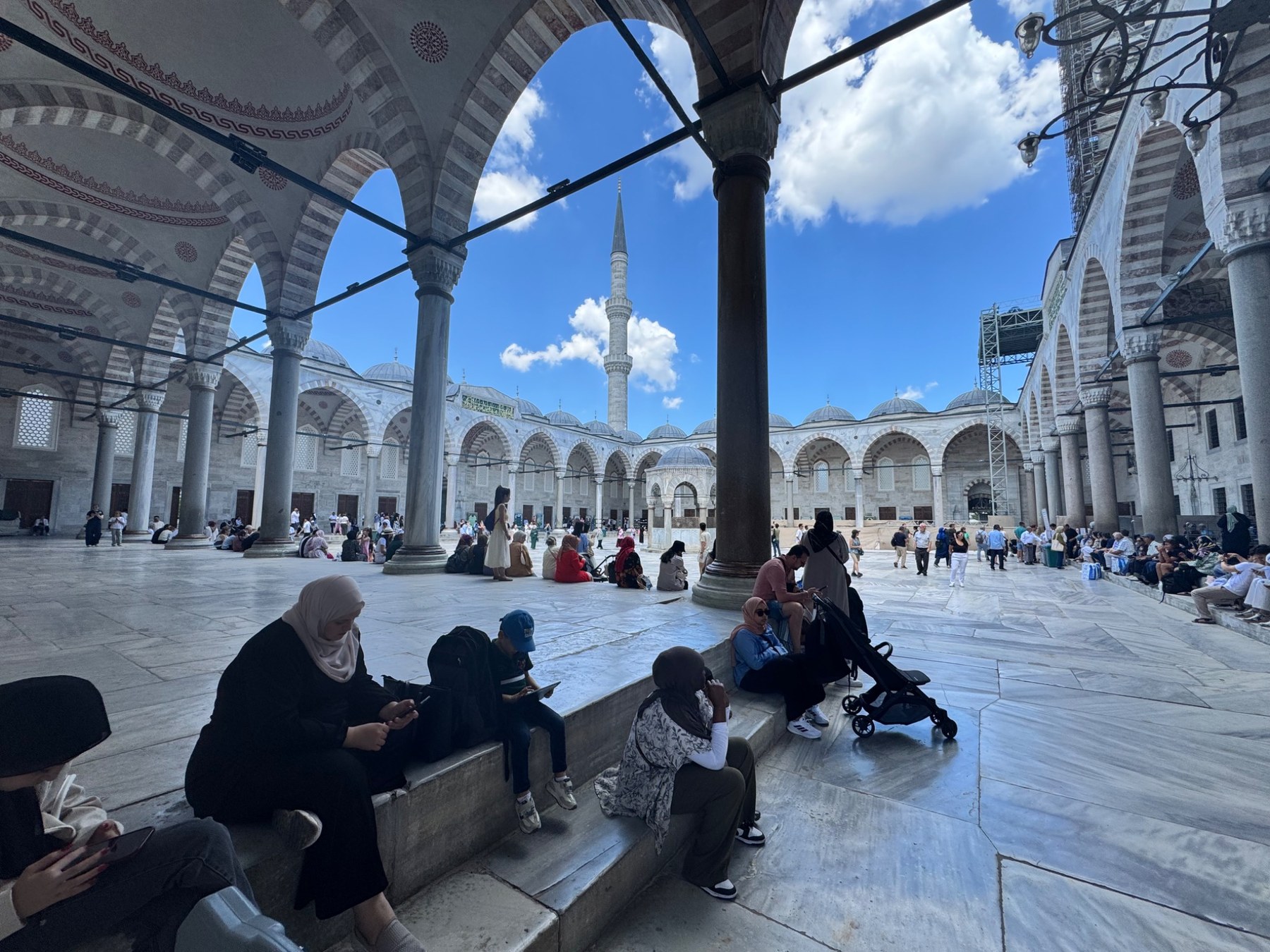
Before you enter the mosque itself, you pass through a large courtyard enclosed by a portico of domed arcades. In the centre, an ablution fountain sits beneath a canopy of its own — a smaller echo of the larger domes above. The courtyard is large enough to absorb a crowd without feeling crowded.

What struck me most was how the courtyard functioned as a deliberate transition — a place designed to slow you down before you entered the sacred space inside. The architecture understood that arrival matters. That moving from the noise of the city into a place of contemplation requires a threshold, a moment of deceleration.

In an era of buildings that take you from street directly to experience, there is something quietly radical about a space that insists on pause. The courtyard does not rush you. It holds you. And by the time you step inside, you are already in a different state of mind.

Blue Mosque courtyard
The courtyard holds you between the city and the sacred — a deliberate architecture of transition
Blue Mosque courtyard full view
04

A Rivalry That Became A Dialogue

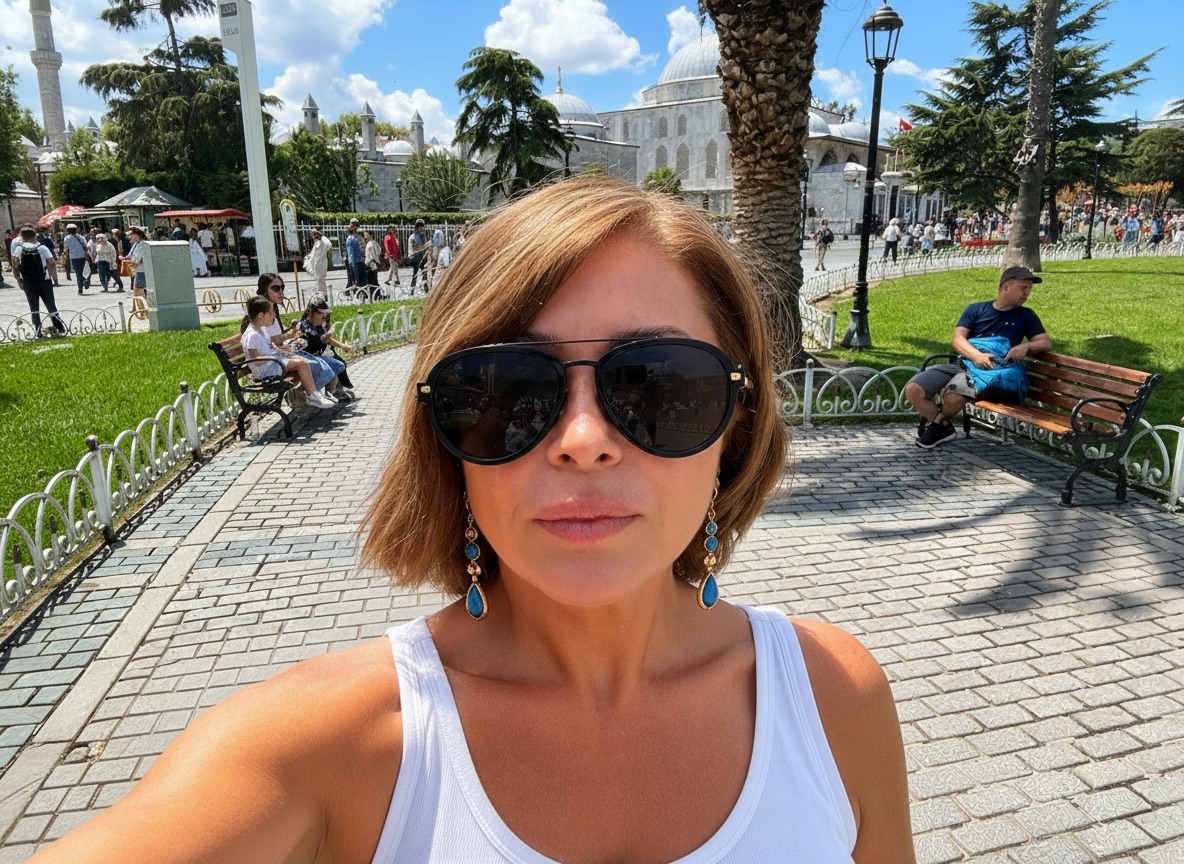
Standing in the garden between the Blue Mosque and Hagia Sophia, it becomes clear that the two buildings are in conversation with each other across four centuries. They share a skyline, a neighbourhood, and — in different ways — a purpose. But their personalities could not be more different.

Hagia Sophia carries the weight of everything that has happened to it. It has been a cathedral, a mosque, a museum and a mosque again. Its interior is stratified with history — Christian mosaics alongside Islamic calligraphy, Roman engineering beneath Ottoman decoration. It does not resolve into a single reading because it was never allowed to.

The Blue Mosque, by contrast, is entirely itself. It was conceived as a single vision and executed with extraordinary consistency. There is no tension inside it, no competing layer that pulls against another. It is resolved in a way that Hagia Sophia never could be — and that resolution produces a different kind of beauty. Not the beauty of history, but the beauty of intention.

What I found extraordinary was that proximity makes both buildings stronger, not weaker. The contrast between them — one restless with meaning, one perfectly composed — creates a tension that enriches both. The city is more interesting because both exist.

Blue Mosque interior

"One captures the imperfection of history. The other captures the perfection of design. Together, they create something neither could achieve alone."

05

What Sydney Can Learn

The Blue Mosque is one of the most opulent buildings I have ever visited. Every surface is covered — tiles, calligraphy, carved stone, painted plasterwork. The scale is extraordinary. And yet it does not feel excessive. It does not feel like too much.

The reason, I think, is restraint within abundance. The opulence is in the detail, not in the statement. Nothing competes for your attention. The blue of the tiles does not shout — it accumulates. The calligraphy does not perform — it rewards. The overall effect is one of richness that has been carefully calibrated so that every element supports every other element. The building knows exactly how much is enough.

Sydney is increasingly comfortable with opulence at a surface level — premium finishes, architectural gestures, statement facades. What we are less practised at is the coexistence of old and new; the idea that buildings of different eras can stand alongside each other and create something more meaningful than either could alone. The Blue Mosque and Hagia Sophia did not erase each other. They defined each other.

That is a different way of thinking about a city — one where every layer adds meaning to the next, rather than replacing it. And it is a standard worth holding ourselves to.

Blue Mosque visit
06

What I Brought Home

Walking out of the Blue Mosque back into the light of Sultanahmet Square, I found myself thinking not about what I had just seen, but about what it meant to stand in a place that knew exactly what it was.

So much of what we build today is hedged — designed to appeal to everyone, to offend no one, to read as contemporary without committing to a specific vision. The Blue Mosque is the opposite of that. It had a clear intention and it pursued it without compromise. The result is a building that has remained compelling for four hundred years.

For those of us advising on projects in Australia, there is a lesson in that clarity of intention. Buildings that last — that people return to, that define neighbourhoods, that become part of a city's identity — are almost always buildings where someone made a decision and committed to it fully. The question worth asking on every project is not what looks good. It is what do we actually believe in — and are we willing to commit to it completely?

A city becomes memorable not because everything matches, but because every layer adds meaning to the next.

Take This to the Round Table

A question worth eight perspectives:

"Are we building places with a clear enough vision to still be compelling in a hundred years — or are we designing for the market cycle rather than the city?"

Bring this question to a Circle8 Round Table →
A Note on How We Work

The Circle8 Global Design Series is not a travel blog. It's a research practice. When we visit a place like the Blue Mosque, we're looking at it through the lens of our work — the residential developments, commercial fitouts and construction projects we advise on in Australia. We're asking: what does this mean for us? What can we take back?

Sometimes the answer is a specific material or detail. Sometimes it's a principle. Sometimes it's just a recalibration of what's possible — a reminder that the standard we're holding ourselves to should be set by the best work being done anywhere in the world, not just the best work being done locally.

Istanbul gave us that recalibration. I hope this edition gives you something useful too.

Share this edition

Circle8 Global Design Series

The world's greatest environments inspire us to think differently.

More editions coming soon. In the meantime, let's talk about what great design could mean for your next project.

More Editions → Start a Conversation